Tourism Potential in India
I have visited many places around the world, including ancient sites, forts and cities. Every time I visit a place, I engage a guide to tell me about what I am seeing. I initially read about the place I am going to visit, go there, listen to the guide and try to understand it. I then come back, read more about the place from all perspectives and write an essay or a poem about it.
This is just to say that I have sufficient experience of tourism. I am also a testimony to how a tourist site and the tourism experience appear from the user’s perspective.
In this light, let me unfold what I perceive tourism to be.
Firstly, what are the characteristics of the participants in the tourism industry?
Historians, archaeologists, public intellectuals, anthropologists, philosophers, laypeople, sensationalists, uninitiated tourists, tourists who want to take something home, tourists who come merely to do something novel, students who come as part of their schooling, ordinary people whose minds and bodies are exhausted by the struggle to earn a living.
The question now is: who is administering the elements and experience of tourism, and to whom among the above-mentioned categories?We can attend many seminars or visit many places. But to what are they appealing?
When I was at school, we were taken on an excursion to Golconda Fort. We were asked to write an essay about it. I was in Class Six at the time.I struggled to write it, but at last I completed it. We went to Golconda on such-and-such a date, followed by the rest of the demographic details, timeline, etc. The points I wrote included the following:
When you clap at the entrance, the sound can be clearly heard at the top of the hill, where the citadel stands. As we were climbing towards the top, we saw some blocks that were used to tether elephants. There were also some very heavy iron weights, perhaps weighing between 50 and 100 kilograms, with rings attached to them. The guide said that people at that time were so strong that one person could easily lift a weight and carry it up the stairs. Later, I learnt that these were actually used to tether elephants.
When we reached the top of the fort, we found a canopy made of brick and mortar. We had to climb a dozen steps to reach it. I described how many steps there were and the height of each one.
When I grew older and started writing poetry, I began comparing my later perspectives with those of my childhood. I will illustrate this through the poems I have written.
Castle
Glowing
over warm lights
on the mountain heights,
thick-armoured power
once sitting in the tower.
Power
that
subjugates.
Subjects obey
to seek order,
as in secure certainty
and constancy.
Both
partners in arms
in the game of thrones.
Author’s notes
Symbiotic— obedience and power,
as bees and flowers,
fuel and fire. Together, they make history
through
thick and thin,
blood and gore.
~ Matcha
The castles that appear so romantic today were once seats of intrigue and brutality, where death and cruelty danced.
It is no different today in the corridors of power, though the violence may be bloodless.
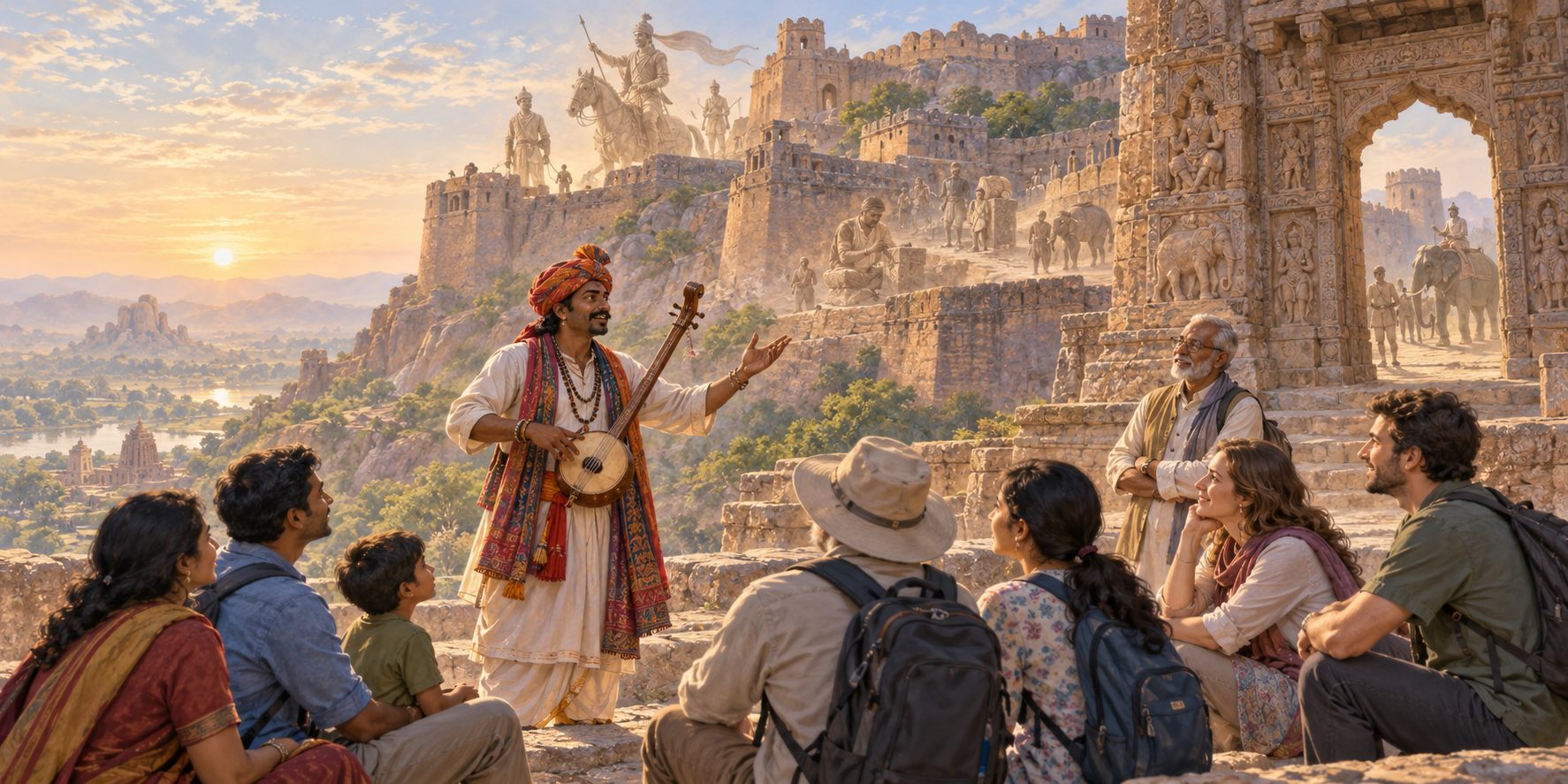
At this juncture, I must say that, as a child and even now, I have felt that the best tourist guides could be traditional folk storytellers. They include Burrakatha and Oggu Katha artists.
Once they tell a historical story, it becomes imprinted upon your whole being: on your intellect, your emotions, your humanity, the artist in you and the warrior in you. You begin to see the historical figures as if they were your ancestors. Historical sites and items are your belongings.
This form of storytelling has a telescopic quality. It contains all the elements of history: the tactical, strategic, theoretical, philosophical, intuitive and even metaphysical. Unfortunately, this art is now considered dated.
The tragedy is that we do not understand the world and human society from an anthropological perspective. That is where the problem lies.
If our tourist guides have all of the embelishments in their narrative, the tourism will develop and also it will realise the purpose of the tourism.
A point of great note is that
History and past happenings are understood, through the language of mythology
According to Joseph Campbell, mythology is a language, art form itself is a message and it requires a special effort to learn it. It is the paramount language that all human beings understand. Listen to Kumar Vishwas’s narration of Gora Badal, which tells the story of Chittorgarh, Rani Padmini, Raja Ratan Singh, Jauhar, and finally, the warriors who rode into the valley of death to live a life of fulfilment.
Watch the narration on YouTube
Image
The narrative of history in the local idiom:
Image
A poetic rendition of history in Hindi. This is the model of how a tourist guide should bring history alive in all its colours. Tourism is not of an academic classroom. It is reliving the past. It is owning our collective heritage. I am sharing these ideas from the other of the isle to the leaders, enthusiasts and powers be in the tourism enterprise.
Matcha