
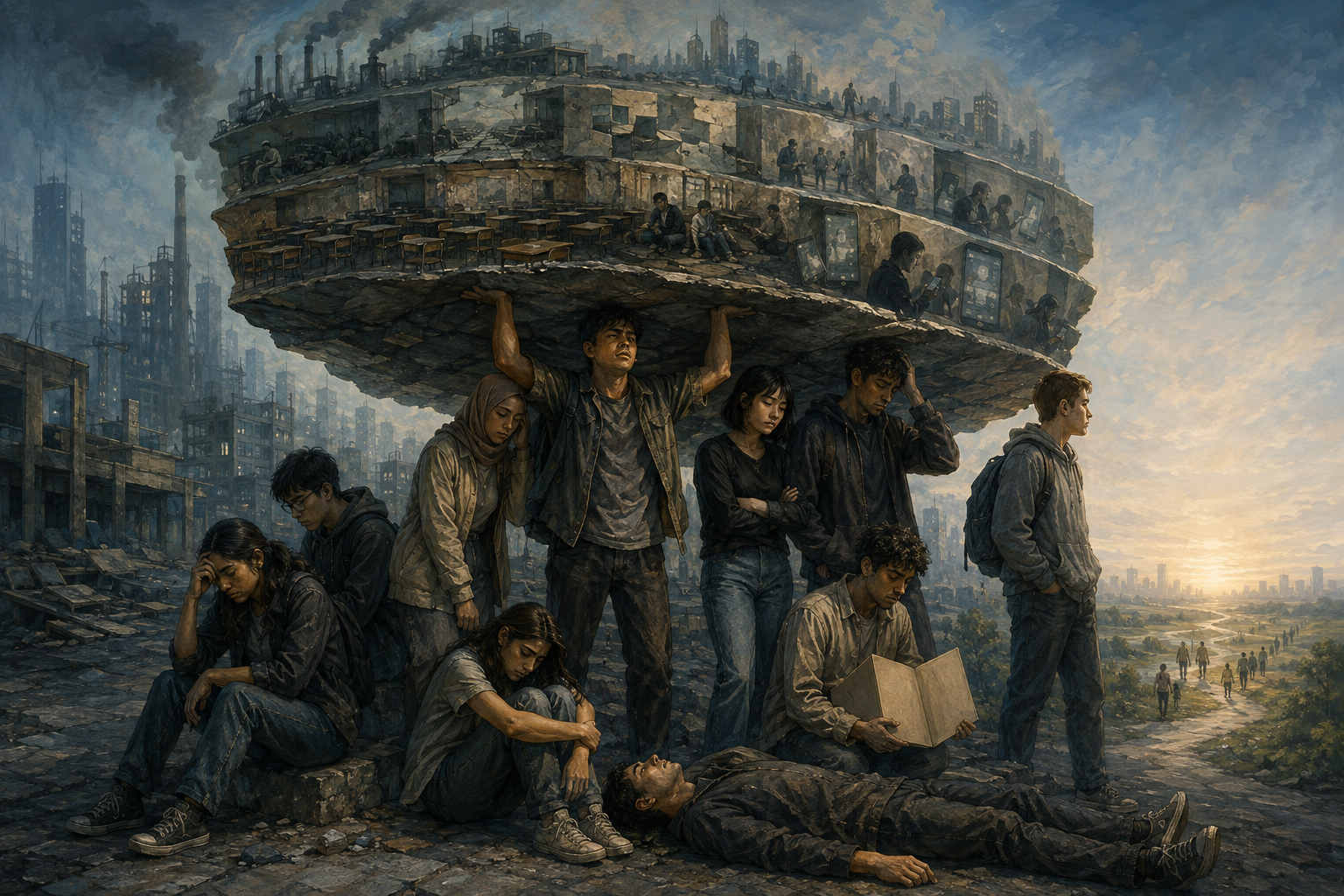
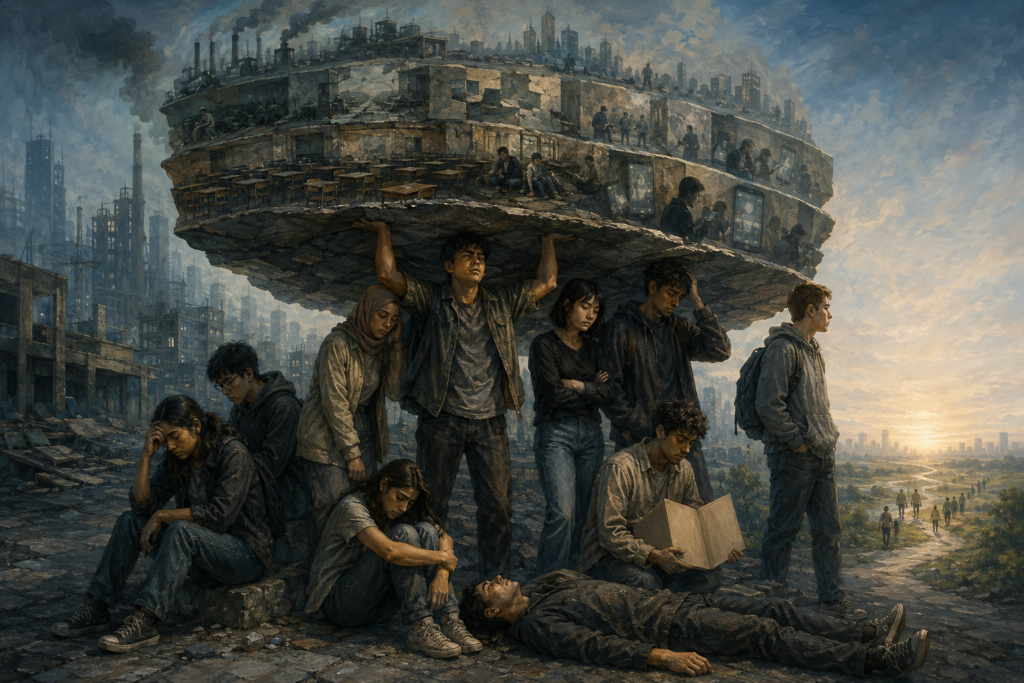
The present generation is going through a deep psychological crisis. Depression is rising. Many young people feel that life has no meaning. Anger against society and the political system is growing. They feel that the future promised to them is no longer available.
This is not happening in one country alone. It is visible across the Western world and in many Asian countries. In China, the Tang Ping, or “lying flat”, movement represents young people choosing to withdraw from the rat race. They no longer want to sacrifice their entire lives for endless work, competition, and material success.
In India, similar frustration is taking a different form. Young people study for years but remain unsure whether they will ever secure stable employment. They do not merely want a job that pays whatever the market offers. They want a living wage—an income that allows a person to support a family, own or rent a decent home, educate their children, and live without constant financial fear.
Youth uprisings in Algeria, Egypt’s Tahrir Square, Libya, Sri Lanka, and Nepal may appear different, but they all contain a similar message: young people are demanding a better life and a meaningful future.
Their anger did not appear suddenly. It is the result of failures that have accumulated over several generations.
The Post-War Gold Rush
The Industrial Revolution began in the eighteenth century, but industrial production grew enormously during and after the two world wars. Following the Second World War, the Marshall Plan and the Bretton Woods system encouraged international trade, reconstruction, and industrial development.
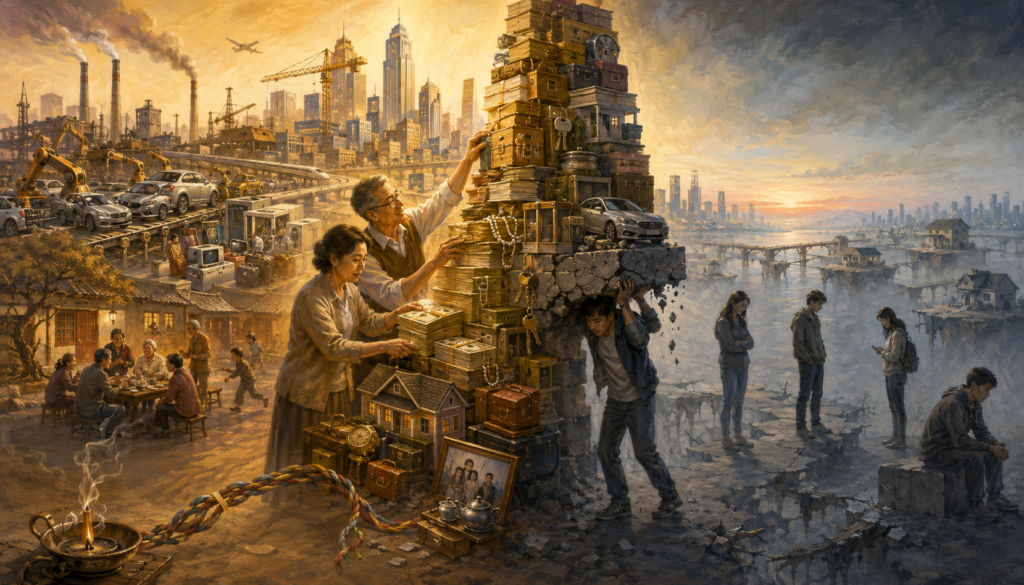
Assembly lines produced goods on a massive scale. Factories expanded, cities grew, and living standards improved. For the first time, large numbers of ordinary people could buy homes, cars, televisions, and household appliances. This brought genuine progress and comfort.
But gradually, money-making and asset accumulation became the main purpose of life. As Keynes warned, the love of money could become a kind of mental disease. Success came to be measured by salary, property, investments, and possessions.
Parents worked hard to build wealth for their children. However, in the process, many became less available as mentors and transmitters of culture. They left behind houses and assets, but often failed to pass on the wisdom, values, emotional strength, and sense of belonging that young people also needed.
Material progress came at a hidden cost.
The Death of Community
The pursuit of individual success weakened families and communities. People moved away from their villages and extended families in search of education, employment, and upward mobility. Neighbours became strangers. Shared responsibilities disappeared. Older people became isolated, while children grew up without the daily support of grandparents and the wider family.
Traditional communities were not perfect. They could be restrictive, unequal, and resistant to change. Yet they also gave people belonging, identity, mutual support, and continuity.
When these structures were dismantled, nothing equally strong replaced them.
Politics also became increasingly divided. Instead of solving problems through discussion and consensus, communities were split into opposing political camps. Religion and spirituality, which once gave many people a moral framework, were either commercialised or pushed aside as outdated.
The moral archway holding society together began to collapse.
The Philosophical Shift

Nietzsche declared that “God is dead”. He was not simply celebrating the disappearance of religion. He was warning that when traditional faith and morality collapse, people may lose the foundation upon which they build meaning and values. The danger, he recognised, was nihilism—the feeling that nothing is ultimately true, valuable, or meaningful.
Later thinkers such as Derrida questioned whether words could have fixed meanings. Foucault examined how knowledge and institutions could be connected to power. These thinkers raised important questions and exposed genuine injustice.
However, their complex ideas were gradually simplified. Questioning a particular truth became the rejection of truth itself. Examining abuses of authority became suspicion of every institution. Challenging harmful traditions became the dismissal of all inherited wisdom.
Popularised postmodernism encouraged the idea that everything was merely a matter of interpretation. Shared truth weakened, morality became relative, and spiritual authority appeared suspicious.
In the name of modernity, the present generation lost its anchor. It is now afloat and drifting.
The Illusion of GDP
Governments constantly speak about economic growth. GDP figures rise, investment increases, stock markets reach new heights, and billionaires become wealthier. These numbers create the impression that society is progressing.
But GDP does not tell us whether an educated young person can find a secure job. It does not tell us whether wages are sufficient to support a family. It does not measure loneliness, anxiety, unaffordable housing, or the fear of an uncertain future.
Economic growth has become separated from employment. Companies can now increase their profits through automation, technology, outsourcing, and financial speculation without creating enough good jobs.
This is jobless growth.
The true measure of an economy should not be how much wealth it produces, but how many people can earn a decent living from meaningful work. Labour, productive industry, and government must work together. Finance should support the real economy—not dominate it.
What Young People Actually Want
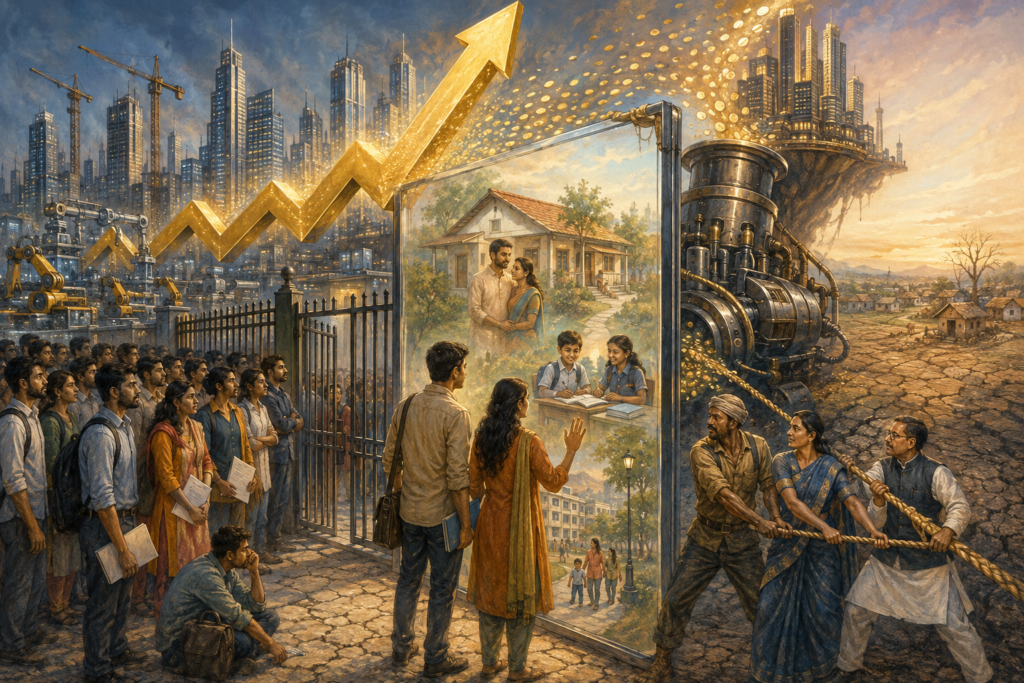
The aspirations of Gen Z are not unreasonable. Most young people are not asking for luxury. They want a secure and well-paid job. They want to marry, start a family, and have a home of their own. They want to give their children a good education and a safe future. They want a decent and dignified life.
When even these basic hopes become unreachable, frustration is inevitable.
A development model designed for wealthy countries with small populations may not work for a country such as India, where millions of young people enter the labour market. India appears to have moved from the slow “Hindu rate of growth” directly into an age of jobless growth, without creating enough secure industrial employment in between.
We may therefore need to move beyond the old argument between capitalism and communism. India needs a socially responsible market economy—perhaps a form of market socialism guided by Dharmic principles. Enterprise and wealth creation should continue, but the economy must also protect human dignity, social responsibility, fairness, and the wellbeing of future generations.
The Rural–Urban Catastrophe
Rural development has been badly neglected. Agriculture has become increasingly uncertain, while villages often lack good schools, healthcare, infrastructure, and employment. Young people are forced to leave—not always because they dislike village life, but because they see no future there.
They migrate to cities in search of opportunity. But cities are not prepared to receive them.
Housing becomes unaffordable. Roads become congested. Public services are overwhelmed. Informal settlements grow, and secure employment remains scarce. People leave behind their families and communities only to become lonely and economically insecure in crowded cities.
They are trapped between a dying rural economy and an uncertain urban future.
Housing policy, urban planning, and rural regeneration must therefore be reconsidered together. Villages need viable employment and good public services. Smaller towns must become centres of education, healthcare, manufacturing, and enterprise. People should be able to build decent lives without being forced into already overcrowded cities.
Education and Cognitive Flattening
Education was once expected to train the mind. Students were taught to read deeply, question carefully, examine evidence, and understand different sides of an argument.
Modern education increasingly offers ideological comfort instead of intellectual challenge. Complicated human problems are reduced to simple divisions: oppressor and oppressed, victim and villain, good and evil.
This produces rigid minds. Young people may become morally passionate but unable to understand the full complexity of the problems they want to solve.
Well-meaning political ideas then become fantasies. People begin to believe that dismantling an institution, overthrowing a system, or silencing an opposing group will immediately solve deep historical problems. They underestimate human nature, unintended consequences, and the difficulty of rebuilding what has been destroyed.
The Technological Echo Chamber
Technology has intensified this problem. Social-media algorithms do not necessarily show us what is true or important. They show us what will keep us watching, clicking, and reacting.
Anger attracts attention. Outrage spreads quickly. Nuanced explanations appear weak beside emotional slogans. People are repeatedly shown opinions they already agree with, creating echo chambers in which opposing views seem not merely mistaken but dangerous or immoral.
Long-form attention is disappearing. Many people struggle to read a serious book, follow a complex argument, or remain with an uncomfortable question. The human mind is being trained to jump from one short burst of stimulation to another.
Knowledge is becoming wider but shallower. We are surrounded by information, yet losing the ability to turn information into understanding and wisdom.
A Multigenerational Legacy
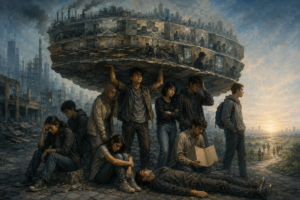
Gen Z did not create this crisis. It inherited it.
Previous generations achieved enormous material progress, but they also weakened communities, neglected rural life, allowed finance to dominate productive industry, made housing unaffordable, reduced education to employment training or ideology, and handed human attention over to technology companies.
The present generation is carrying the accumulated burden.
Its anger should not simply be dismissed as laziness, entitlement, or rebellion. It is a warning that the social contract is breaking down. A society cannot remain stable when young people no longer believe that honest work will give them a decent life.
The answer is not to reject modernity and return blindly to the past. Nor is it to dismantle every inherited institution. We must keep the achievements of modern life while recovering what has been lost: meaningful employment, affordable homes, strong families, living communities, rigorous education, responsible technology, spiritual depth, and a shared moral foundation.
Gen Z does not need another false promise. It needs a genuine future.
~ Matcha




2 responses
Wonderful analysis! The decline was gradual and it reached peak in the current generation of youth. I am not a big fan of the use of this borrowed terms on generations, hence I do not want to use Gen Z. Your diagnosis of the problem with current society is very accurate. A government which can improve the quality of life of an average citizen is a successful one, as you rightly said the growth in GDP doesn’t mean anything to a struggling citizen with poor income for sustaining the life.
Excellent article.
You conveyed the message of the current state of affairs beautifully, with ‘youngsters of today’ as a focal point, as it should be. For they will bear the consequences.
‘The Technological Echo chamber’ sums up the current situation and possibly future! Scary.
Thank you! for you gave words to my thoughts.