
Yesterday, I gave a presentation on the Upanishads and documented the experience. This morning, I was listening to Acharya Prashant, trying to understand his method of teaching.
The first question posed to him was whether the Western education system is the reason we do not read our spiritual stuff. He counter-questioned whether the questioner themselves had read them. He then pointed out that we are a sovereign nation and an electoral democracy, meaning we have the power to change this ourselves by electing those who govern.
The second question asked was why people do not read these texts. Yesterday, during my presentation, I shared my own understanding of why people avoid Brahma Vidya (spiritual knowledge which is a bit esoteric).
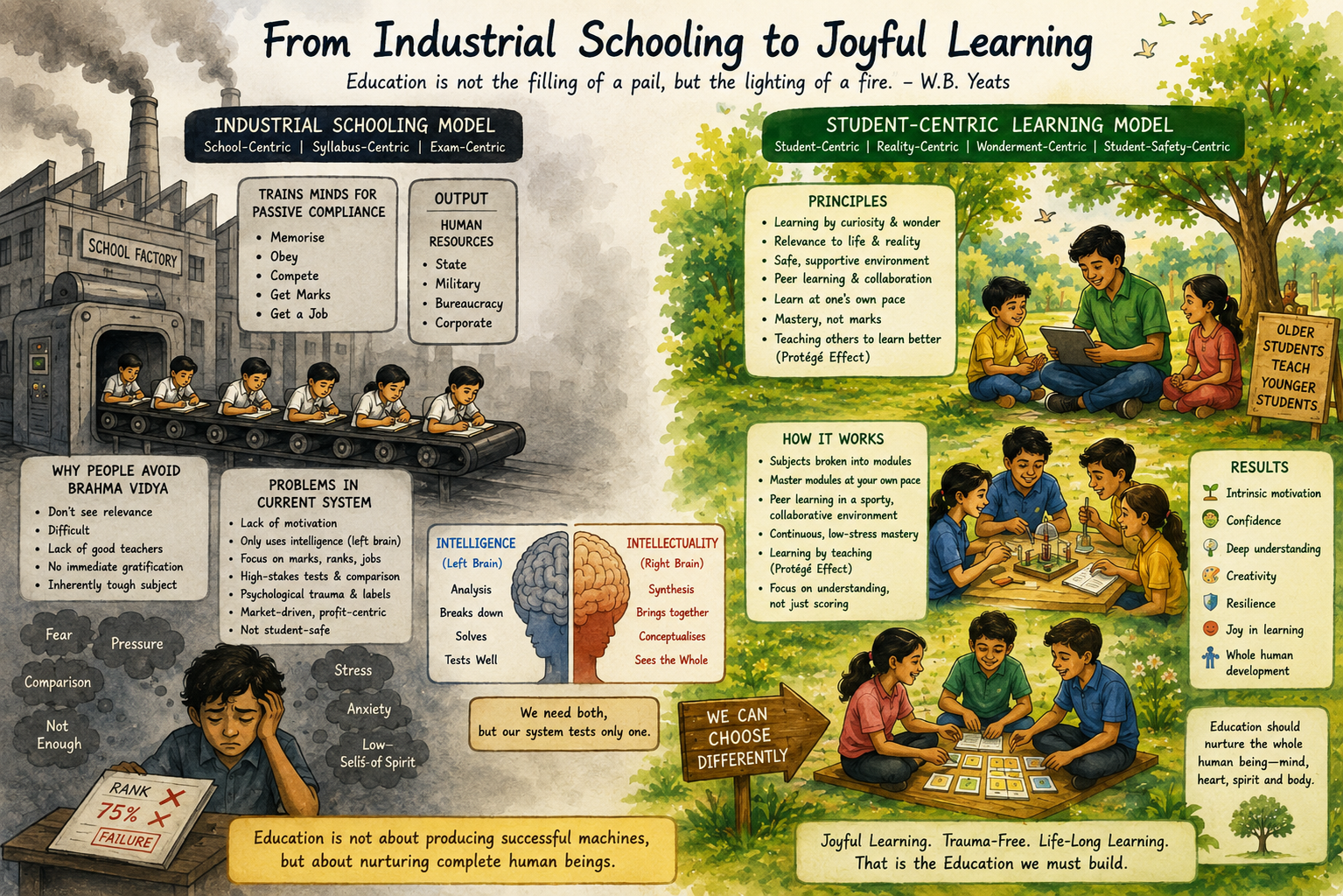
I enumerated several reasons: people do not see its relevance to daily life, they find it difficult, there is a lack of good teachers, there is no immediate gratification, and it is an inherently tough subject. Acharya Prashant mentions that we must battle with it, engage with it, incubate it, and revisit it rather than blindly accepting it. However, to do all of this, an individual must be motivated—either internally or through an external agency.
Now I move on to secular education. The children and adults too are no more interested in acquiring knowledge. There is no motivation at all for acquiring knowledge.
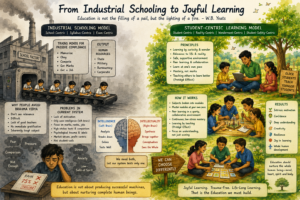
The industrial schooling model, however, trains minds for passive compliance, not rigorous internal inquiry.
We must look at the attractiveness of education through the lenses of sociology, psychology, and anthropology. It is no wonder that institutions like Cambridge have a dedicated faculty chair for the Sociology of Education.
We can apply these same lenses to secular education. The primordial stumbling block in education is that people lack the motivation to learn, an issue that must be addressed at a deeper level.
From a sociological perspective, schools function primarily as sorting mechanisms for economic utility rather than sanctuaries for truth. Anthropologically, human learning evolved through play, imitation, and community integration—not isolated desks and standardized tests. When secular education divorces itself from human wonder, it loses its intrinsic worth. By viewing education through these social sciences, we see that the lack of student motivation is not a personal failure of the child. It is a predictable response to an unnatural environment.
I also discussed the difference between intelligence and intellectuality. Intelligence is traditionally related to the analytical left brain, while intellectuality—in this context—is related to the right brain’s capacity for synthesis. Synthesising is the opposite of analysis; it involves bringing disparate pieces of information together to make sense of them or to conceptualise them.
Our current education system merely utilizes and tests intelligence. The entire system is aimed at scoring marks, gaining ranks, and securing employment. It has very little to do with seeking knowledge, understanding, or wisdom. This is exactly where the education system falls flat.
Furthermore, we are administering education on an industrial scale through standardized schools and schooling systems.
To put it another way, our current approach is school-centric and syllabus-centric. Another phenomenon occurring in society is the rise of private and international schools. These institutions are driven heavily by market forces and parental demands. The resulting pedagogy is nothing more than the industrial production of human resources to serve state purposes, military, bureaucracies, and corporate industries.
There is a distinct lack of education that is student-centric, reality-centric, wonderment-centric, and, crucially, student-safety-centric.
By “student-safety-centric,” I mean addressing the psychological toll of the current system. When parents deposit their children into schools, those children are judged and valued almost exclusively by the marks they achieve. Ranking systems ensure that those with high marks zoom ahead in life, securing better jobs and financial stability. But what happens to the students who do not achieve top ranks? What is the psychological side effect on them? These students are often labelled as failures, sustaining subliminal trauma that strips away their spirit for life.
Instead, can we not build a truly student-centric education system? In such a system, subject matter would be broken down into modules. Students would master these modules at their own pace through peer learning in a sporty, collaborative environment. Furthermore, older students could teach younger classes. By learning the technique of teaching, they would subconsciously master the technique of learning itself.
This alternative model replaces high-stakes testing with continuous, low-stress mastery. In a modular framework, a student does not move forward because a calendar dictates it, but because they have genuinely grasped the concept. Integrating the “learning by teaching” methodology—known globally as the Protégé Effect—transforms the classroom dynamic. It shifts the student from a passive consumer of information to an active creator of knowledge. There are already schools in India operating on these principles and producing fantastic results. They foster task-oriented focus and mastery, turning education back into what it was always meant to be: a joyful, trauma-free exploration of reality.
Matcha